Share what you see
Give the address, heater type and where water is appearing.
Know what happens from the first call to the provider’s assessment and agreed work.
Call with the location of the water and your property address. The accepting provider confirms whether they can help, when they can visit and any assessment charge.
Call to check current availability.
Give the address, heater type and where water is appearing.
The accepting provider confirms service coverage and a suitable time.
Discuss the source, repair options, written scope and price.
Authorize the work directly and ask about checks and follow-up.
The provider adapts the inspection to the heater and conditions at the property. These are assessment questions, not instructions for opening the unit yourself.
Identify tank or tankless equipment, fuel type, the model label and the location of the wet area.
The provider determines suitable isolation and access before inspecting or opening equipment.
Inspect the hot and cold connections and follow water tracks that may run down the outside of the heater.
Where relevant, distinguish a leaking fitting from safety-valve discharge and assess contributing pressure or expansion conditions.
Look at drain valves, accessible gaskets, connection points and tankless fittings as appropriate for the model.
Explain whether the source is repairable, whether additional investigation is needed or whether tank replacement should be discussed.
Confirm the written scope. Ask how the repaired area will be checked after service and what follow-up terms apply.
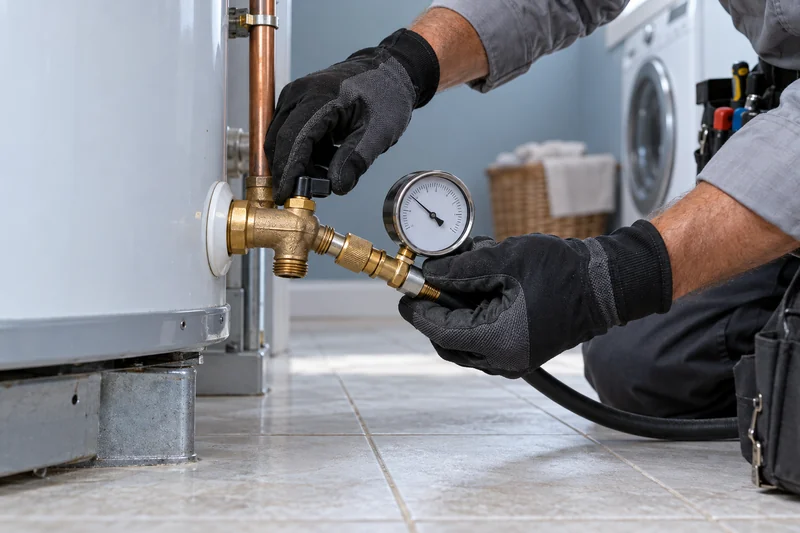
A puddle alone does not tell you which part has failed. Discuss the water’s starting point, the heater type and access at your property.
Use these questions to compare the proposed work and understand what you are authorizing.
Describe where water first appears. Ask the provider to explain the leaking part rather than treating every puddle as a failed tank.
A serviceable external fitting and a leaking tank body call for different work. Ask which option fits the equipment condition.
Recurring discharge may require more than a new valve. Discuss pressure, expansion and model-specific checks with the provider.
Confirm the business identity, relevant credentials, parts, labor, price, testing and follow-up terms in writing.
The source of the leak determines the work. Request separate assessment, parts and labor details before agreeing to proceed.
Prices and assessment charges are set by the accepting independent provider. This website does not promise a fixed national price, free assessment or same-day appointment.
Tell us where you see water. Discuss your address, the heater and an assessment with an independent provider.
Have these details ready so the accepting provider can assess the request.
Confirm the provider’s identity, coverage and assessment terms before booking.
your location can be checked in the service-area directory.
Directory inclusion does not guarantee acceptance for every property.
Browse service locations